Request a UK-to-Austria freight assessment
Tell us your collection and delivery details, cargo format and dimensions. We confirm feasibility before any booking.
B2B Cargo moves commercial B2B cargo from the United Kingdom to Austria by road, subject to shipment and route checks. Share your details for an assessment.
Request a UK-to-Austria freight assessment
Tell us your collection and delivery details, cargo format and dimensions. We confirm feasibility before any booking.
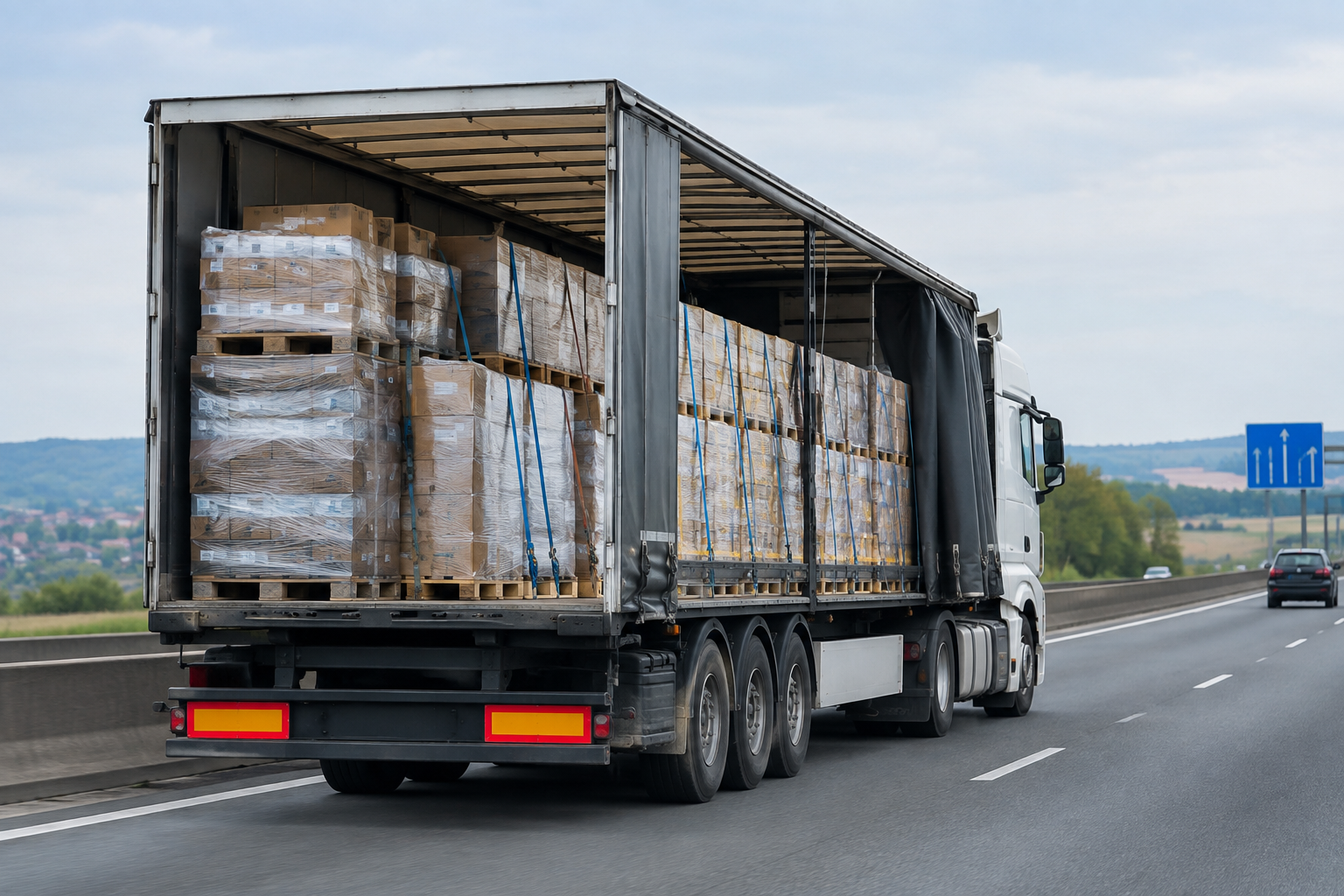
B2B Cargo arranges commercial B2B road freight from the United Kingdom to Austria using pallet delivery, LTL / groupage freight, dedicated vans and full truck load (FTL). Cargo acceptance and route feasibility depend on the shipment, and UK-origin customs planning may be required.
No fixed B2B Cargo price applies to UK-to-Austria freight; the table below shows third-party public market examples only, not B2B Cargo quotations or tariffs. Recheck the source before relying on any figure, since actual freight pricing varies with postcodes, dimensions, weight, service, access and customs requirements.
To request a qualified quotation, share: collection and delivery addresses, cargo format (boxes, parcels, pallets, crates or IBC containers), dimensions and weight, and any handling requirements. Actual accepted dimensions depend on the selected service and route, and collection and delivery conditions depend on the shipment and route. Service feasibility is confirmed only after this information is assessed.
| Service | Example price (GBP) | Conditions |
|---|---|---|
| 1 pallet | from £240 | 120 x 80 x 80 cm, stackable |
| Express van | from approximately £1,400 | – |
| Full truck load | around £1,916 | – |
These are third-party public market examples, not B2B Cargo quotations or tariffs.
These are third-party public market examples, not B2B Cargo quotations or tariffs. Recheck the source before relying on a price; actual freight pricing varies with postcodes, dimensions, weight, service, access and customs requirements.
UK-to-Austria shipments can be planned toward Vienna and Lower Austria, Linz, Wels, Steyr and Enns in Upper Austria, and Graz and Styria, subject to shipment and route checks.
Vienna and Lower Austria form Austria's largest concentration of international company headquarters. Upper Austria, around Linz, Wels, Steyr and Enns, is a production and automotive centre with its own logistics strategy. Graz, the principal city of Styria, sits among clusters covering automotive, medical technology, electronics and timber.
Other Austrian regions may also be reachable, but actual address-level delivery remains subject to shipment, cargo and route checks rather than a fixed coverage list.
These regional notes describe planning context only, not guaranteed coverage for every address.
Vienna and Lower Austria hold a large share of Austria's international company headquarters, with Vienna accounting for almost half of those identified in a national study. This reflects general business density, not an established frequency of UK shipments into the region, and address-level feasibility still depends on the shipment and route.
Upper Austria, centred on Linz, Wels, Steyr and Enns, hosts an automotive sector reporting around 31,000 employees and roughly €11.5 billion turnover across about 280 companies and research institutions. The region runs a dedicated logistics strategy, treating logistics as central to its production location.
Graz and Styria host industry clusters spanning automotive, aerospace and rail systems (ACstyria Mobility Cluster, around 300 companies), medical technology and pharmaceuticals (Human.technology Styria), electronics (Silicon Alps), timber and environmental technology.
Regional business and industry context does not guarantee delivery to a specific address. Actual shipment and route feasibility is checked case by case before confirmation.
LTL/groupage freight to Austria typically takes approximately 4 to 15 working days. Dedicated van transit typically takes approximately 48 to 96 hours after pickup. Exact transit depends on the shipment and route.
LTL / groupage timing depends on route, load, terminal handling and service conditions. Dedicated van timing depends on distance and route conditions.
Public transport corridors provide background context only. The Rhine–Danube corridor runs through Wels, Linz and Vienna, connecting west to Strasbourg, Stuttgart and Munich and east to Bratislava, Budapest and the Black Sea region. The Baltic–Adriatic corridor passes through Vienna toward Czechia, Slovakia and Poland to the north and Italy, Slovenia, Croatia and Hungary to the south. Neither corridor establishes a B2B Cargo routing or delivery-time commitment.
Freight from Great Britain to Austria involves separate UK export and EU import steps, plus an entry-safety filing at the first EU entry point; Northern Ireland movements follow different procedures.
UK–Austria trade in goods and services totalled £10.2 billion in 2025, made up of £4.2 billion in UK exports to Austria and £6.0 billion in UK imports from Austria.
In the four quarters to Q1 2026, leading UK goods exports to Austria included cars (£313.8 million), medicinal and pharmaceutical products (£207.3 million), specialised machinery and capital goods (£84.1 million), non-ferrous metals (£81.6 million) and other intermediate manufactures (£67.8 million).
This trade evidence describes what UK businesses export to Austria; it does not confirm that B2B Cargo accepts any specific goods, which remains subject to shipment and route checks.
Austria has a distributed intermodal terminal network across Vienna, Upper Austria, Styria and western regions, which can be relevant to planning but does not commit B2B Cargo to any specific terminal.
Vienna South Freight Centre offers intermodal handling, storage and customs-clearance options across a 250,000 m² site with six 700-metre loading tracks and road access from the S1, A2, A4, A21 and A23. Ennshafen, on the Upper Austria and Lower Austria border, is a trimodal transshipment and container hub covering 3.5 million m² with 2,500 metres of quayside on road, rail and the Danube. The Port of Vienna's Freudenau terminal is a trimodal container facility reporting around 126 rail services per week and 470,000 TEU throughput in 2024, with rail links toward Rotterdam, Hamburg, Bremerhaven and the Ruhr area.
This public infrastructure illustrates the scale of Austrian freight handling; it does not establish that B2B Cargo routes shipments through any named terminal.
Austria applies daily night bans and separate weekend and holiday bans for heavy goods vehicles, alongside toll, emissions and lane rules that need a route-specific check.
UK export trade to Austria includes automotive goods, medicinal and pharmaceutical products, specialised machinery, non-ferrous metals and intermediate manufactures, based on leading UK goods-export categories to Austria.
Medicinal and pharmaceutical products can carry product-specific temperature, security, licensing or regulatory requirements.
UK export categories relevant to Austria describe market patterns, not confirmed B2B Cargo acceptance; actual cargo acceptance depends on the shipment and route. Household removals and personal effects are outside B2B Cargo's stated positioning on this website.
Provide the collection address in the UK and the delivery address in Austria, along with the intended shipment date.
State the cargo format (boxes, parcels, pallets, crates or IBC containers), dimensions, weight and any handling requirements. Actual accepted dimensions depend on the selected service and route.
Based on the shipment, a suitable service family is assessed among pallet delivery, LTL / groupage freight, dedicated vans and full truck load (FTL), and actual acceptance is confirmed.
UK export and EU import responsibilities, required documents and any preference claim are identified before booking.
Shipment and route feasibility, collection and delivery conditions, and booking arrangements are confirmed before the shipment is scheduled.
Last updated: 2026-09-20
No, B2B Cargo is not positioned as a household-removals or personal-effects service on this website. The route pages describe commercial B2B road-freight services for businesses shipping commercial cargo to Austria.
No, the price examples shown are third-party public market examples, not B2B Cargo quotations or tariffs. Recheck the source before relying on any figure, since actual freight pricing varies with postcodes, dimensions, weight, service, access and customs requirements.
No, weekend pickup or delivery is not promised as a standard service. Collection and delivery conditions depend on the specific shipment and route, so weekend options, if any, would need to be checked case by case.
No, cargo acceptance is not guaranteed for every shipment. Boxes, parcels, pallets, crates and IBC containers may be considered, but actual acceptance depends on the cargo, its dimensions, the selected service and the route.
No, not necessarily. An Entry Summary Declaration for entry-safety purposes applies at the first physical EU entry point, but full import clearance can instead happen later under the optional Common Transit Convention route to an Austrian office of destination or authorised consignee.
Share your collection and delivery details, cargo format, dimensions and handling needs. We assess shipment and route feasibility before confirming any booking, with no price, capacity or delivery-date promised in advance.