Request a UK-to-Ireland freight quote
Tell us your cargo, quantities and Irish delivery point and we will confirm feasibility.
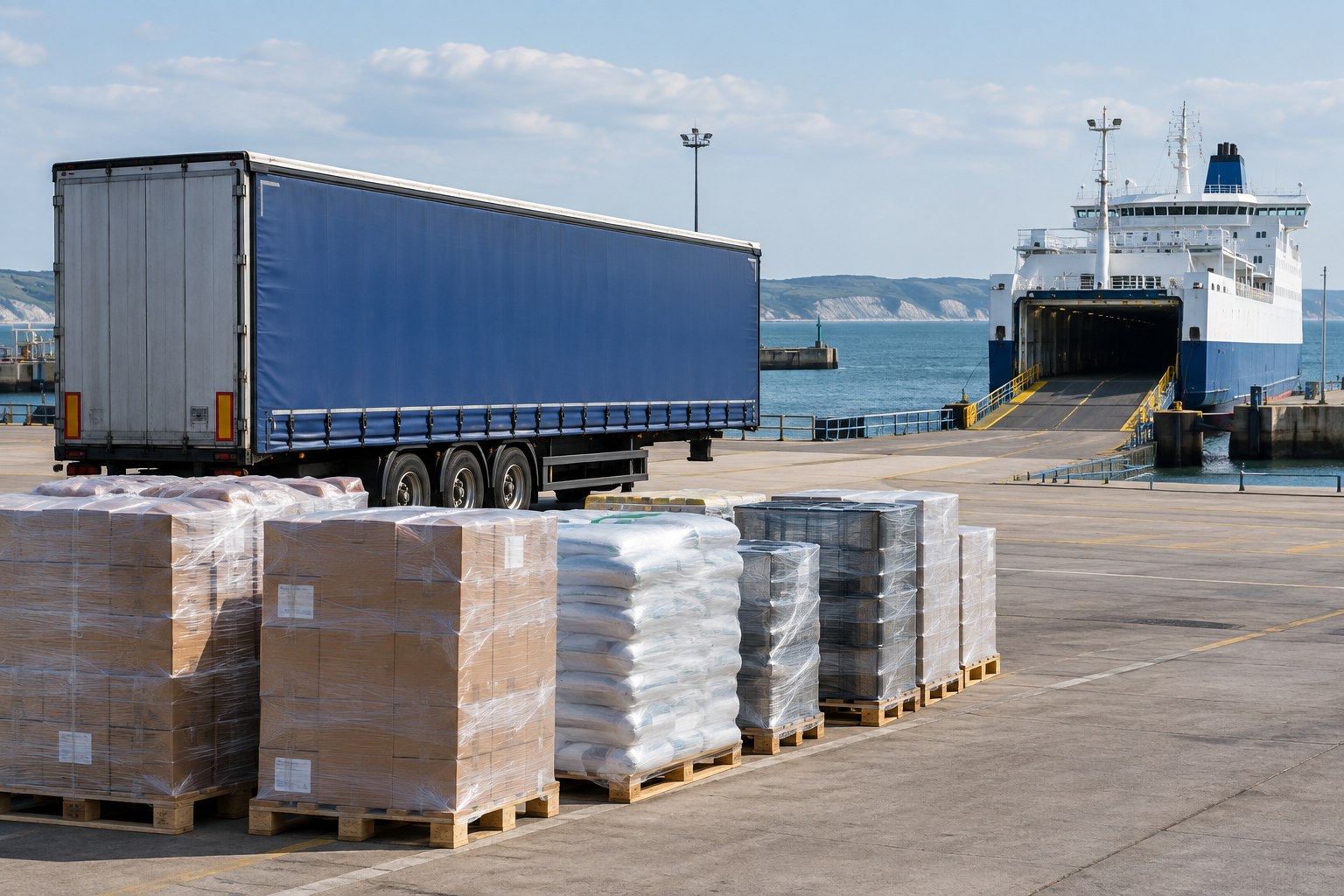
Commercial road-and-ferry freight between Great Britain and Ireland, covering pallets, groupage, dedicated vans and full truck loads across the Irish Sea.
Request a UK-to-Ireland freight quote
Tell us your cargo, quantities and Irish delivery point and we will confirm feasibility.
Yes, B2B Cargo arranges commercial B2B road freight from the UK to Ireland, subject to checks on the specific shipment and route. Because Ireland is reached only by crossing the Irish Sea, every movement includes a ferry leg rather than continuous overland transport.
Indicative net prices from the UK to Ireland start at £260 for 1 Euro pallet, £450 for 2 Euro pallets and £620 for 3 Euro pallets. These are exact test-pilot “from” prices; they are not calculated per-pallet rates and no other quantities are implied.
| Quantity | Price (from, net) |
|---|---|
| 1 Euro pallet | from £260 |
| 2 Euro pallets | from £450 |
| 3 Euro pallets | from £620 |
Indicative test pricing for the private pilot site. Final live pricing will be replaced before launch.
The right corridor depends on your collection point in Great Britain and your delivery region in Ireland.
Holyhead–Dublin and Liverpool–Dublin are direct maritime freight corridors into Dublin, published by Dublin Port, carrying cargo such as perishable food, consumer and retail stock and industrial materials or machinery. Fishguard–Rosslare and Pembroke–Rosslare are direct RoRo freight corridors into Rosslare, each published at twice-daily frequency by Rosslare Europort.
Dublin suits shipments needing access to Ireland's national motorway network, while Rosslare suits deliveries concentrated in south-east Ireland. Beyond these two gateways, Ireland's other relevant freight nodes include Cork, Limerick/Shannon Foynes, Waterford and Galway, recognised as TEN-T urban or maritime nodes. Published sailing frequencies are corridor context only; they are not B2B Cargo collection, sailing or delivery commitments.
Sea crossing and Irish customs steps set this route apart from mainland European corridors.
UK-to-Ireland road freight always includes an Irish Sea leg, and island and sea-leg destinations like Ireland can require different routing than a continuous overland journey. This crossing can also mean additional handling at the port compared with a purely road-based route.
Pallet delivery, LTL/groupage freight, dedicated vans and full truck load (FTL) are the core road-freight service families that can be considered for this route. Which one fits depends on your cargo volume, dimensions and delivery point.
Boxes, parcels, pallets, crates and IBC containers are cargo formats that may be accepted, but every format remains subject to route and cargo acceptance checks before a booking is confirmed.
Service feasibility depends on the shipment and route, so B2B Cargo confirms acceptance, service choice and any handling conditions against your actual cargo details rather than assuming a standard outcome.
Transit times are service-family ranges, not a route-specific promise, because of the sea crossing.
LTL/groupage freight typically takes approximately 4 to 15 working days, depending on route, load, terminal handling and service conditions. Dedicated van delivery typically takes approximately 48 to 96 hours after pickup, depending on distance and route conditions.
Exact transit for UK-to-Ireland shipments depends on the specific shipment and route, and mainland-style transit is not promised for island destinations like Ireland because a ferry crossing is required. Dublin corridors (Holyhead–Dublin, Liverpool–Dublin) and Rosslare corridors (Fishguard–Rosslare, Pembroke–Rosslare) publish their own sailing frequencies, but this published sailing information is corridor context and not a collection or delivery commitment from B2B Cargo.
These records apply to commercial goods brought from Great Britain into Ireland; they are practical checkpoints, not legal advice.
The Irish importer must submit an electronic import declaration, or appoint a customs broker to submit it on their behalf. An electronic Entry Summary Declaration must be submitted before departure from Great Britain, and the carrier is responsible for ensuring this submission happens.
Only one Pre-Boarding Notification is created per vehicle, even when it carries multiple consignments, and a vehicle cannot board the ferry in Great Britain without a valid Pre-Boarding Notification. On arrival, the vehicle's customs-routing status can be checked through the Customs Channel Look-up, which becomes available 30 minutes before arrival at the Irish port; drivers carrying goods must not leave the port without customs clearance. Separately, a nil or reduced customs-duty claim under the EU–UK Trade and Cooperation Agreement is not automatic simply because goods are dispatched from the UK — the goods must satisfy the relevant rules of origin.
Bilateral trade figures show the scale of goods movement this route supports; they describe the market, not confirmed B2B Cargo cargo acceptance.
In the four quarters to 31 March 2026, total UK–Ireland trade reached £90.9 billion, making Ireland the UK's 6th-largest trading partner overall and its 4th-largest goods export market. Medicinal and pharmaceutical products were the leading reported UK goods export category to Ireland in that period, followed by refined oil and gas, then cereals and other consumer manufactures among the top five categories.
Refined oil and gas appear here as trade context only; they are not cargo offered or accepted by B2B Cargo on this route.
Each Irish gateway serves different cargo types and regions.
Dublin Port handled 944,102 RoRo units and 530,235 LoLo units in calendar year 2025, alongside 119,200 trade vehicles, making it Ireland's principal RoRo gateway for UK freight. Rosslare Europort operates RoRo freight connections including Fishguard–Rosslare and Pembroke–Rosslare, each published at twice-daily frequency.
The Port of Cork operates across four locations in Cork Harbour, handling lift-on lift-off, roll-on roll-off, liquid bulk, dry bulk and break bulk cargo, with a deepwater container terminal at Ringaskiddy serving industries such as information technology, medical technology, pharmaceuticals, chemicals and agri-food. Shannon Foynes Port, on the Shannon Estuary in County Limerick, recorded total throughput of 9.36 million tonnes in 2025 and serves energy, agriculture, construction, bulk and containerised cargo for western Ireland, with planned road and rail hinterland connections to Limerick.
These conditions can affect onward delivery after the ferry crossing, particularly into central Dublin.
Ireland's national road network spans 5,314 km, including 1,200 km of motorway and dual carriageway, carrying an estimated 80 to 90 percent of road freight; tolling includes the state-managed M50 and Dublin Tunnel plus eight separate PPP toll schemes.
Dublin Tunnel connects Dublin Port to the M1 south of Dublin Airport, and goods vehicles with a design gross vehicle weight exceeding 3,500 kg are exempt from Dublin Tunnel tolls, preserving direct national-road access for HGV traffic serving the port. Within central Dublin and Sandymount, heavy goods vehicles with five or more axles face restricted-hours cordons (07:00–19:00 daily for the central cordon, 24 hours for Sandymount) and need a load/unload permit valid only for premises registered with Dublin City Council. Vehicles too wide for Dublin Tunnel, or carrying restricted goods, must use a restricted-goods permit and the prescribed East Wall Road and Alfie Byrne Road route.
These examples come from official trade statistics, not confirmed shipment eligibility for a specific booking.
Medicinal and pharmaceutical products were the largest reported UK goods export category to Ireland in the four quarters to Q1 2026. Cereals and other consumer manufactures also ranked among the five largest reported categories in the same period.
Product-specific temperature, security, licensing or regulatory requirements may apply to any of these goods, and service feasibility still depends on the actual shipment and route. These examples reflect trade evidence only; they do not confirm that B2B Cargo will accept a particular consignment.
Provide the collection and delivery locations and the intended shipment date. Collection and delivery conditions depend on the shipment and route.
State the cargo format, dimensions, weight and any handling requirements. Actual accepted dimensions depend on the selected service and route.
Assess the shipment against pallet delivery, LTL / groupage freight, dedicated vans and full truck load (FTL), then confirm feasibility for the actual route and load.
For UK-origin international freight, applicable customs formalities are identified before booking. Requirements depend on the shipment and route.
Confirm service feasibility and the collection and delivery conditions for the actual shipment before scheduling.
European road freight services – See the full European Road Freight service that covers this and other UK-origin routes.
Last updated: 2026-09-21
No, B2B Cargo is not positioned as a household-removals or personal-effects service on this website. It supports commercial B2B road-freight movements only, so household or personal shipments fall outside this route's scope.
No, weekend pickup or delivery is not promised as a standard service. Any weekend arrangement would need to be checked and confirmed separately against your specific shipment.
These are examples of goods reflected in UK–Ireland trade evidence, but they are not automatically accepted. Medicinal and pharmaceutical products, cereals and other consumer manufactures rank among the leading UK goods exports to Ireland, though product-specific handling or regulatory requirements may apply, and acceptance still depends on the actual shipment and route.
It can, depending on the vehicle and address. Heavy goods vehicles with five or more axles delivering or collecting inside the central Dublin or Sandymount restricted area during restricted hours need a load/unload permit, valid only for premises registered with Dublin City Council.
No, goods vehicles with a design gross vehicle weight exceeding 3,500 kg are exempt from Dublin Tunnel tolls. This exemption preserves direct national-road-network access for HGV traffic serving Dublin Port.
No, a nil or reduced customs-duty claim is not automatic simply because goods are dispatched from the UK. Under the EU–UK Trade and Cooperation Agreement, the goods must satisfy the relevant rules of origin before preferential tariff treatment applies.
The vehicle's routing is determined by the Customs Channel Look-up, based on the declaration references in its Pre-Boarding Notification, and becomes available 30 minutes before arrival. Possible outcomes range from exiting the port directly to being called for a customs, transit or seal check, and drivers carrying goods must not leave the port without customs clearance.
Share your cargo format, quantity, dimensions, collection point and Irish delivery point. B2B Cargo confirms feasibility and conditions against your actual shipment.